Is federalism in retreat under single-party hegemony?

News:
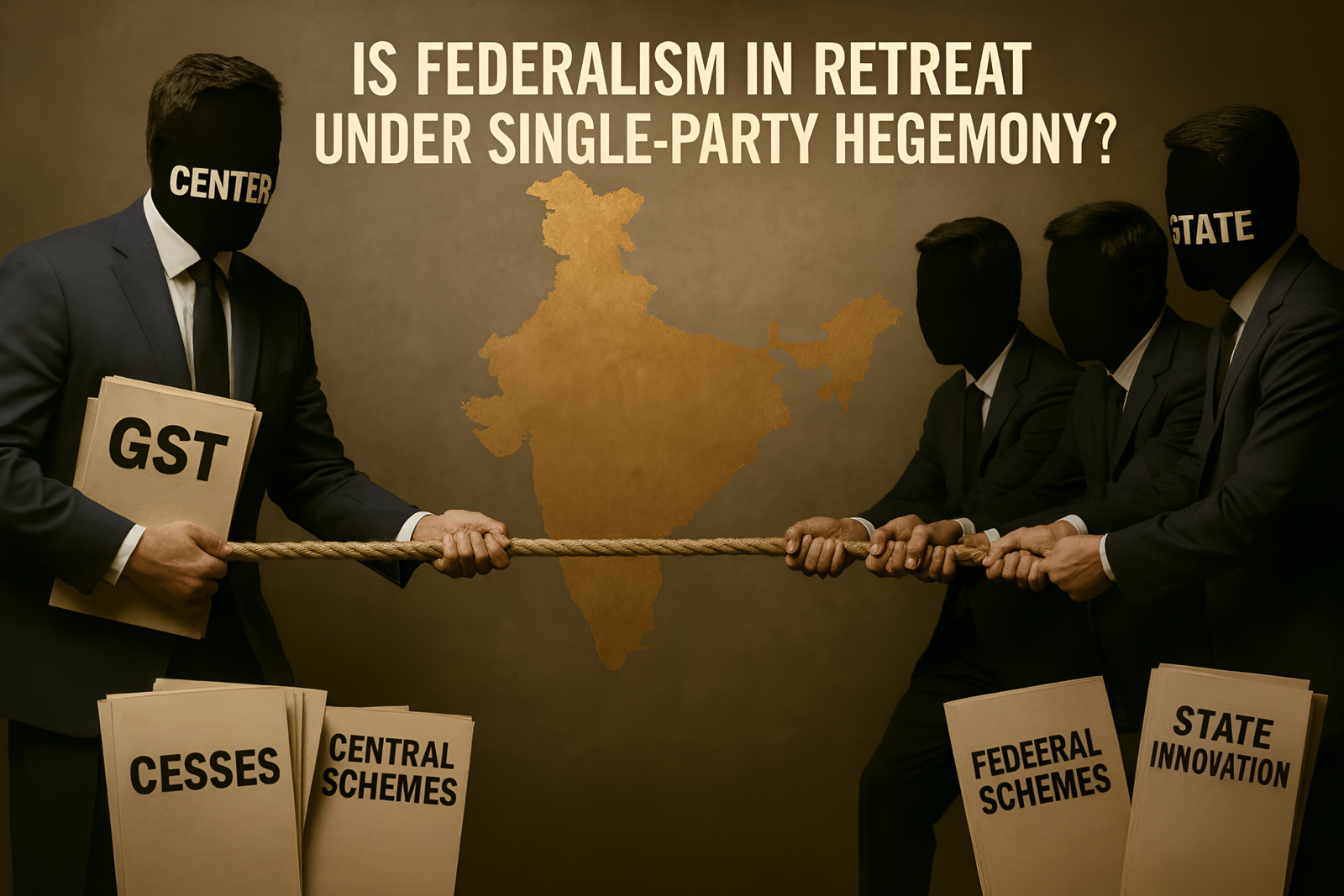
Recently, a fresh showdown erupted between the Centre and Opposition-ruled States over the new GST 2.0 reforms — underscoring deepening strains in India’s federal fiscal architecture. Eight States have warned that proposed tax-rate changes could slash their revenues by as much as ₹2 lakh crore annually, demanding a five-year compensation guarantee from the Centre.
Arguments in Favour of federalism in retreat under single-party hegemony
1. Rising Fiscal Centralisation Erodes State Policy Freedom
The Centre’s growing use of cesses, surcharges, and rigid schemes increasingly restricts States’ ability to frame independent welfare priorities, shrinking their fiscal autonomy and widening structural dependence on central approvals.
- Example: Non-shareable cesses significantly reduce devolved revenue, narrowing States’ developmental flexibility and long-term spending space.
2. GST Council Tilt Restricts Genuine Cooperative Federalism
Although designed for shared taxation, the GST framework gradually displays central dominance, as critical rate changes and compliance mandates often overshadow States’ fiscal sovereignty and negotiation capacity.
- Example: Several States felt GST decisions were predetermined, limiting their influence during Council discussions and undermining deliberative consensus.
3. Weakening Institutional Dialogue Limits State Voice
The removal of the Planning Commission dissolved a crucial consultative platform, pushing States into fragmented interactions with individual ministries, reducing long-term coordinated development planning and institutionalised federal bargaining.
- Example: Scheme guidelines are now centrally framed, providing minimal channels for structured State-level negotiation or policy adaptation.
4. Pan-Indian Unification Narratives Shrink Regional Autonomy
Increasing emphasis on uniform national models sidelines regional linguistic and cultural diversity, gradually weakening States’ capacity to assert policy distinctiveness and political identity within India’s asymmetrical federal structure.
- Example: Measures like One Nation, One Election raise fears of diminishing regional political bargaining and policy differentiation.
5. Administrative Levers Used for Political Pressure
Targeted delays in financial transfers, environmental clearances, or disaster relief create asymmetric leverage, enabling partisan pressure on Opposition-ruled States and undermining the neutrality of federal institutions.
- Example: Multiple States approached the Supreme Court alleging discriminatory withholding of centrally-linked funds during critical administrative phases.
6. Centralised Electoral Funding Weakens Regional Parties
Dominance of centralised political financing, especially after electoral bonds, disproportionately strengthens national parties, reducing regional parties’ bargaining power and narrowing pluralistic federal representation.
- Example: Bond disclosures showed national parties receiving overwhelming funding, limiting regional parties’ influence in federal negotiations.
Arguments Against federalism in retreat under single-party hegemony
1. Rising Judicial Activism Protects State Autonomy
The Supreme Court increasingly safeguards State rights, intervening against arbitrary central actions and reinforcing constitutional boundaries that preserve India’s cooperative federal balance and prevent excessive central dominance.
- Example: Recent judgements upheld States’ fiscal claims, affirming constitutional limits on unilateral central financial manoeuvres.
2. Inter-State Councils and Zonal Platforms Regaining Relevance
Greater activity in Zonal Councils and revived inter-state mechanisms strengthens horizontal federalism, enabling States to jointly negotiate national reforms, security coordination, and policy adaptations more assertively.
- Example: Southern States collaborated on fiscal concerns, amplifying regional bargaining strength within national decision-making.
3. State Innovation Models Driving Competitive Federalism
States increasingly pioneer policy innovations in health, education, digital governance, and welfare, compelling the Centre to replicate or recognise regional models, thus expanding bottom-up federal influence.
- Example: Kerala’s health initiatives and Odisha’s disaster governance became national templates, showcasing State-led policy leadership.
4. Regional Parties Still Shape National Politics
Despite funding asymmetries, strong regional parties continue influencing coalition politics, parliamentary debates, and national agendas, sustaining pluralistic federal competition and policy divergence.
- Example: Regional parties have blocked or reshaped major bills, exerting decisive influence in parliamentary negotiations.
5. States Expanding External and Economic Engagement
Many States increasingly pursue global cooperation, investment summits, and climate diplomacy, exercising subnational foreign policy, thereby enhancing their strategic autonomy, competitive capacity, and broader global economic bargaining power.
- Example: Gujarat, Tamil Nadu, and Maharashtra host major global investor summits, strengthening independent economic leverage.
6. Decentralised Governance Reforms Increase Local Autonomy
Strengthening urban local bodies, digital governance, and grassroots institutions gives States additional administrative layers of power, reinforcing multi-level federalism and reducing singular central dependence.
- Example: Municipal reforms in several States improved local revenue autonomy, expanding independent governance capabilities.
Conclusion:
India’s federal trajectory today reflects neither linear decline nor effortless balance but a complex negotiation between central authority and rising State assertiveness. While fiscal and institutional centralisation has tightened Union dominance, States are simultaneously expanding influence through innovation, welfare experimentation, and global engagement. The future of Indian federalism will depend on restoring trust-based cooperation, strengthening intergovernmental dialogue, and recognising that national strength ultimately grows from empowered, capable, and confident States.