Introducing AI in School Curriculum

News:
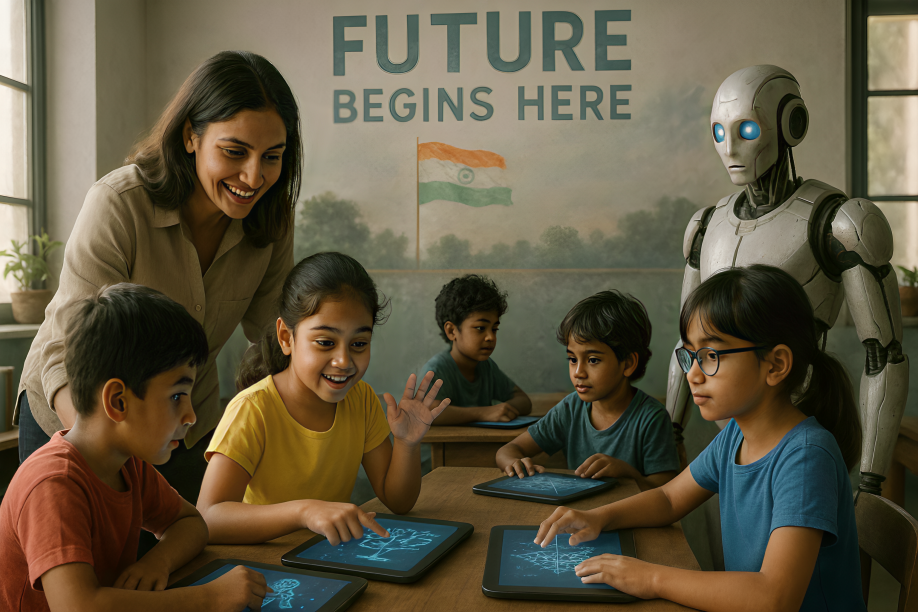
Recently, the Ministry of Education announced plans to introduce Artificial Intelligence (AI) education from early grades under the ‘Skilling for AI Readiness’ initiative, aiming to equip students with digital-age skills. The move aligns with India’s National Education Policy 2020, seeking to make the next generation AI-literate, innovative, and globally competitive.
Arguments in Favour of Introducing AI in School Curriculum
1. Early Familiarity Builds Future Competence
Introducing Artificial Intelligence (AI) from Class 3 allows students to develop logical reasoning, creativity, and problem-solving when their minds are most adaptable. The aim isn’t to teach coding to children but to cultivate curiosity about how intelligent systems think and operate.
- Example: In Singapore and the UAE, AI concepts are introduced through interactive games and visual learning tools, helping students understand everyday technologies like chatbots or voice assistants in a playful way.
2. Bridging the Skill Gap for India’s Digital Future
With the global AI industry expected to cross $1.5 trillion by 2030, India needs a workforce fluent in digital intelligence. Introducing AI early ensures a steady pipeline of skilled innovators, aligning education with national priorities like Digital India and Atmanirbhar Bharat.
- Example: The ‘Skilling for AI Readiness’ initiative by the Ministry of Education already enables thousands of CBSE schools to teach AI fundamentals and train teachers, helping India nurture a generation that creates technology rather than merely consumes it.
3. Encouraging Ethical and Responsible AI Use
Starting AI education early gives children an understanding of data privacy, bias, and misinformation, shaping them into responsible digital citizens. When ethical discussions begin young, future developers are more likely to build technology that serves society fairly.
- Example: Finland’s “Elements of AI” program integrates ethics with technology, teaching students that AI should enhance human values — a model India could adapt to balance innovation with moral awareness.
4. Empowering Rural and Underserved Students
AI-powered learning tools can personalize education, helping students in rural or under-resourced areas learn at their own pace. Intelligent tutoring systems can fill the gap left by shortages of qualified teachers and limited access to quality materials.
- Example: Platforms like DIKSHA and PM eVIDYA can use AI to analyze student progress, recommend tailored lessons, and support multilingual education, ensuring that no learner is left behind.
5. Supporting the Vision of NEP 2020
The National Education Policy (NEP) 2020 emphasizes 21st-century skills such as critical thinking, computational logic, and interdisciplinary learning. Introducing AI fits perfectly within this framework by connecting science, ethics, and creativity in one space.
- Example: Integrating AI modules into Maths, Science, and Social Studies promotes project-based learning, where students design real-life solutions — from traffic management models to crop prediction tools.
6. Boosting India’s Global Competitiveness
Early AI literacy strengthens India’s position as a leader in emerging technologies. It equips future citizens with the mindset to innovate, collaborate, and adapt in a rapidly changing world.
- Example: Programs like the International AI Olympiad and AI-for-All campaigns show how early exposure to AI not only builds essential digital skills but also instills strong national confidence in long-term scientific innovation and leadership.
Arguments Against Introducing AI in School Curriculum
1. Premature Exposure May Hinder Foundational Learning
Introducing Artificial Intelligence (AI) from Class 3 risks overwhelming children before they’ve even mastered reading, writing, and numeracy. At that age, students need play-based learning, not abstract tech concepts. Early exposure might create surface-level familiarity without real understanding, leading to what experts call “dis-education.”
- Example: A study by Professor Stuart Russell (UC Berkeley) warned that overdependence on AI tools in early education can erode motivation and critical thinking among young learners.
2. Deepening the Digital Divide
India’s education system already faces stark inequalities — many schools lack computers, electricity, or trained teachers. Introducing AI may widen the gap between urban elite schools and rural government ones, reinforcing social and economic divides instead of reducing them.
- Example: About 9% of Indian schools have just one teacher, and 35% operate with fewer than 50 students and two teachers. Expecting such schools to deliver AI lessons risks excluding millions from the so-called “AI revolution.”
3. Lack of Trained Teachers and Infrastructure
Teaching AI requires instructors skilled in both technology and pedagogy. Yet most Indian teachers lack even basic digital literacy. Rushing implementation without proper preparation will make the curriculum tokenistic and ineffective.
- Example: The National Council for Teacher Education (NCTE) reports that nearly half of India’s teachers lack formal qualifications. Without systematic training and support, the AI curriculum could become another checkbox subject rather than a transformative skill.
4. Psychological and Ethical Risks for Children
AI chatbots and virtual assistants can blur the line between machine and human interaction, especially for impressionable children. Many already use AI tools for companionship or validation, raising concerns about privacy, data security, and mental health.
- Example: The Youth Pulse Study showed that 42% of students shared information with AI they’d normally discuss with real people — a sign of emotional displacement and digital dependency.
5. Rapid Technological Obsolescence
AI evolves faster than curriculums can adapt. Topics like prompt engineering or specific programming frameworks may be outdated within a few years, making the content irrelevant by graduation. Instead of rigid syllabi, students need adaptability and lifelong learning skills.
- Example: Within just a year, the shift from GPT-3 to GPT-5 redefined what counted as “AI literacy.” Static school content cannot keep up with such rapid innovation cycles.
6. Distraction from Core Educational Priorities
India is still struggling with basic literacy and numeracy deficits. Pushing AI too early risks diverting funds and focus from essential learning goals, creating a mismatch between policy ambition and classroom reality.
- Example: The ASER 2023 Report found that only 43% of rural Class 5 students could read a Class 2-level text. Emphasizing AI before mastering basics may prioritize glamour over genuine learning.
Conclusion:
Introducing AI at an early stage can be a constructive step if built on solid educational foundations. Rather than rushing adoption, India should pair early exposure with strong teacher training, infrastructure, and ethical guidance. This balanced approach prevents the digital divide while preparing students for a future where human judgment and machine intelligence grow together, not apart.