Do we need to change how cities are governed in India?

News:
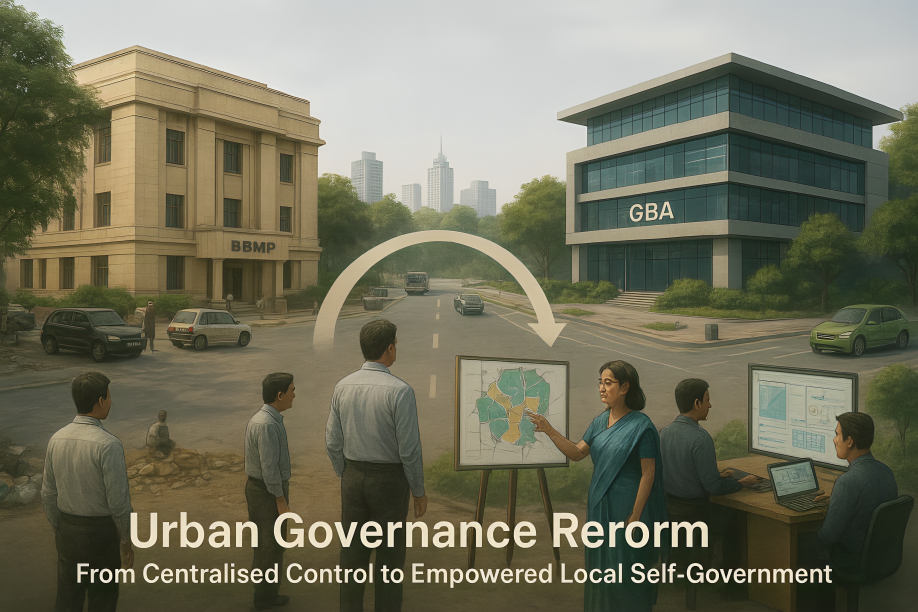
Recently, the Greater Bengaluru Authority (GBA) officially replaced the Bruhat Bengaluru Mahanagara Palike (BBMP), initiating a major reorganisation into five municipal corporations. This significant reform aims to enable decentralised governance, enhance urban service delivery, improve civic infrastructure, strengthen local accountability, and ensure more efficient planning and management of Bengaluru’s rapidly growing city.
Arguments in Favour of Reforming Urban Governance in India
1. Strengthening Local Democracy and Accountability
Elected Mayors and empowered municipal bodies act as visible points of citizen accountability. Currently, the Chief Minister’s office controls most city affairs, leaving urban residents with limited avenues to resolve local issues. A democratically empowered Mayor ensures faster responses, improved grievance redressal, and encourages public participation.
- Example: In the U.S., Mayors wield substantial powers over city budgets, policing, and urban development, giving citizens a direct interface for civic redress.
2. Enhancing Efficiency in Service Delivery
Decentralisation with financial and administrative autonomy allows municipal bodies to make quick, localised decisions. Presently, bureaucratic and state-level dominance slows down infrastructure, sanitation, and utility services. Localised decision-making ensures priority needs are met efficiently.
- Example: Ward-level fund devolution in 1980s Hyderabad enabled rapid completion of minor infrastructure projects, demonstrating the practical impact of fiscal empowerment.
3. Facilitating Responsive Urban Planning
Urban planning is often disconnected from ground realities, causing misaligned projects and delays. Empowered municipal bodies can design policies tailored to local needs, coordinate public-private partnerships, and plan for sustainable urban growth.
- Example: Participatory budgeting in Porto Alegre (Brazil) shows how citizen-driven planning improves transparency and ensures resources reach priority areas.
4. Reducing Political Interference and Overreach
Municipal autonomy reduces MLA, MP, and Chief Minister interference, allowing civic institutions to function independently. Clear delineation of responsibilities prevents territorial or political conflicts, making governance more efficient.
- Example: City corporations in Singapore operate autonomously, ensuring policy decisions reflect urban priorities rather than political agendas.
5. Promoting Civic Awareness and Participation
Visible local governance fosters civic literacy, encouraging residents to understand government functions and participate in local development. Enhanced awareness strengthens community engagement and accountability.
- Example: In Seoul, citizens actively participate in city governance through digital platforms, contributing to policy design and oversight.
6. Strengthening Urban Resilience and Disaster Management
Empowered municipal bodies can respond swiftly to disasters, manage emergencies, and implement sustainable urban policies. Local leadership ensures resources are allocated effectively and vulnerabilities addressed proactively.
- Example: Tokyo’s local disaster management system relies on city-level autonomy for effective coordination during earthquakes and floods.
Arguments Against Reforming Urban Governance in India
1. Entrenched Political Resistance
State governments may actively resist decentralisation of power, as it significantly reduces the influence and control of Chief Ministers and dominant political parties over urban territories. Without broad political consensus and cooperation across parties, proposed reforms often remain symbolic or partially implemented, limiting their effectiveness and impact on improving governance, accountability, and service delivery at the city level.
- Example: In Bengaluru, municipal elections have been repeatedly postponed under the guise of BBMP restructuring, reflecting political manipulation.
2. Administrative Capacity Constraints
Many municipal bodies lack trained personnel, robust systems, and institutional memory. Simply empowering Mayors or devolving funds may not produce tangible results unless accompanied by technical and human capacity building.
- Example: Smaller municipalities struggle with urban planning due to lack of skilled officers, data, and effective coordination.
3. Risk of Fragmentation or Overcentralisation
Merging or splitting municipalities without careful planning can create inefficiencies, confusion, and delays. Poorly executed restructuring may hamper service delivery rather than improve it.
- Example: Merging 27 municipalities into GHMC in Hyderabad risks misallocation of funds if local-level priorities are overlooked.
4. Overlapping Jurisdictions and Policy Gaps
Many urban challenges—transport, water supply, pollution, waste management—transcend municipal boundaries. Empowering Mayors alone cannot solve regional or inter-city problems, requiring state-level coordination.
- Example: Delhi suffers from unresolved civic issues due to overlapping authority of the Union government, State government, and Municipal Corporation.
5. Financial Limitations of Municipal Bodies
Even with autonomy, many municipal bodies have limited revenue bases, restricting their ability to fund large-scale infrastructure, health, or transport projects independently. Reliance on state grants may continue, limiting true fiscal independence.
- Example: The BBMP in Bengaluru struggles to fund major infrastructure projects independently due to limited local revenue.
6. Risk of Localised Political Capture
Empowered local bodies may be dominated by local elites or dominant groups, leading to favouritism, exclusion of marginalised communities, and misalignment of priorities. Without accountability mechanisms, decentralisation may worsen inequity and corruption.
Example: Certain wards in Kolkata and Tamil Nadu municipalities consistently show bias in resource allocation, often favoring politically connected areas over marginalized communities.
Conclusion:
Reforming urban governance in India is essential to make cities more responsive, accountable, and efficient. Empowered Mayors and financially autonomous municipal bodies can strengthen local democracy, improve service delivery, and foster citizen participation. However, political resistance, administrative limitations, and risks of local capture must be addressed. A balanced approach, combining structural reform, capacity building, and citizen engagement, is crucial to ensure sustainable, inclusive, and effective urban governance.

Thank you for your sharing. I am worried that I lack creative ideas. It is your article that makes me full of hope. Thank you. But, I have a question, can you help me? https://www.binance.info/cs/register?ref=OMM3XK51