- A neighbourhood Holi gathering where busy residents forget deadlines for an hour, laugh, throw colours, and walk back home actually feeling human again.
Public Religious Celebrations and Expressions
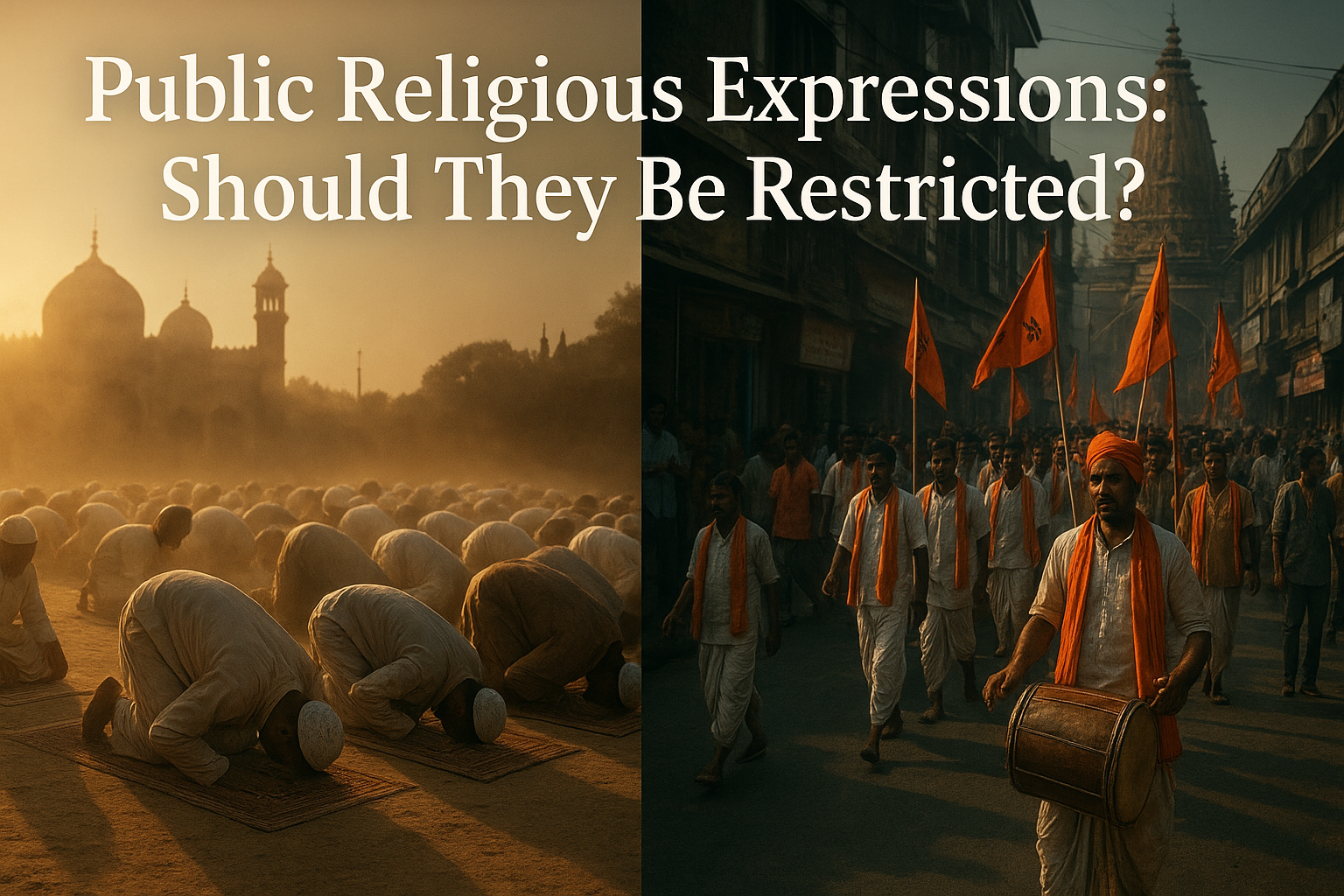

News:
Recently, a viral incident at Bengaluru Airport showing public namaz and a parallel loudspeaker crackdown in Uttar Pradesh reignited a sharp national debate. As questions grow over how much religious expression belongs in shared civic spaces, India confronts an uneasy dilemma: can public devotion coexist with order, equality and everyday civic comfort, or are these collisions now becoming unavoidable?
Arguments in Favour of Public Religious Celebrations and Expressions
1. Preserving Cultural Identity
Public religious celebrations help protect traditional practices, rituals, and art forms that might otherwise vanish in rapidly modernising societies. When people gather collectively, they reaffirm shared heritage and ensure that younger generations witness cultural continuity. Traditional crafts, music, and rituals survive more effectively in open community spaces than in private settings.
- Example: Durga Puja in West Bengal keeps centuries-old art and rituals alive through pandals, craftsmanship, and community gatherings.
2. Enhancing Social Cohesion
Festivals create shared emotional experiences that strengthen social bonds. People from diverse economic and social backgrounds interact in the same public space, reducing isolation. Events that encourage collective participation help develop neighbourhood harmony and familiarity across groups.
- Example: Langars during Gurpurab and Iftaar gatherings in Ramadan invite people of all backgrounds to share food, encouraging unity.
3. Boosting Local Economies
Public festivities generate significant economic activity. Artisans, vendors, small traders, transportation providers, and service workers benefit from increased demand. Seasonal employment rises, supporting families reliant on informal work. The festival economy creates high-volume income cycles for local communities.
- Example: Pushkar Fair (Rajasthan) and Kumbh Mela (Prayagraj) draw millions, boosting hotels, craftsmen, transport, and local markets.
4. Encouraging Interfaith Visibility and Respect
Open celebrations of multiple traditions help normalise diversity. When various groups celebrate publicly, it reduces prejudice and reinforces equality in shared civic spaces. Visibility of different customs encourages inter-community respect and fosters a climate of coexistence.
- Example: Ganesh Chaturthi mandals in Maharashtra bring neighborhoods together for organising events, charity drives, and collective immersion ceremonies.
5. Facilitating Civic Engagement and Volunteering
Large-scale festivities often include charity initiatives, health camps, food distribution, and clean-up drives. These activities help strengthen a sense of civic responsibility. Community groups mobilise volunteers who contribute to welfare-oriented collective action.
- Example: ISKCON’s food distribution, Jain community medical camps, or Seva activities during Sikh festivals show real welfare aligned with festivities.
6. Providing Emotional Relief and Social Expression
Public celebrations offer people avenues to express joy, gratitude, and identity. In high-stress urban life, these gatherings act as emotional outlets that boost mental well-being. They create safe, communal environments that allow cultural pride to be expressed openly.
Arguments Against Public Religious Celebrations and Expressions
1. Strain on Public Order and Civic Infrastructure
Large gatherings often lead to traffic disruptions, slower emergency services, and pressure on civic systems. Roads, public spaces, and transport networks become congested for hours. This overload affects residents’ daily routines, increases fuel consumption, and stretches administrative, sanitation, and policing resources far beyond normal capacity.
- Example: Major roads in Mumbai and Delhi choking during processions, causing delayed ambulances and blocked emergency routes.
2. Noise and Environmental Impact
Firecrackers, loudspeakers, and continuous gatherings contribute to noise pollution and deteriorating air quality. Regardless of community, excessive sound or pyrotechnics violate environmental norms. Such disturbances especially affect infants, hospital patients, elderly citizens, and students. Repeated exposure also harms pets and local wildlife.
- Example: High-decibel loudspeakers for Azaan or Diwali/New Year fireworks exceeding legal noise limits.
3. Risk of Political Misuse
Public celebrations can be exploited for identity-based mobilisation. When religious expression becomes a show of numerical strength, it sharpens divisions. Groups may use processions for political messaging, provocation, or demonstrating dominance, shifting the focus from devotion to confrontation.
- Example: Certain groups turning Morchas into aggressive displays of strength instead of spiritual expression.
4. Exclusion of Non-Participants
People who are ill, elderly, working night shifts, or preparing for exams may face unavoidable inconvenience. Public religion, when loud or unregulated, can impose participation on those who prefer peace. Forced exposure to crowding or amplified sound can trigger anxiety, sleep loss, and physical discomfort.
- Example: Residents in sensitive localities feeling unsafe when large groups march with loud slogans, creating stress for families and disrupting the calm of daily neighbourhood life.
5. Unequal Access to Public Space
Some groups receive more administrative support than others, creating a perception of bias. When permissions or visibility vary, the principle of equal treatment in civic spaces gets undermined. Smaller communities may struggle to secure venues or logistical help.
- Example: A small tribal community denied a space while larger festival committees secure faster approvals.
6. Safety and Crowd Management Challenges
Dense gatherings carry risks of stampedes, fires, and structural collapses. Without proper barricading, emergency exits, and structural checks, festive spaces become hazardous. Inadequate planning can turn minor issues into major accidents.
Example: A festival mandap collapsing due to weak construction, injuring people in a densely packed crowd and causing unexpected panic as rescue teams struggle to reach the site quickly.
Conclusion:
Public religious celebrations reflect cultural continuity, social unity, and economic vitality, yet they also risk public inconvenience, environmental strain, and political misuse when left unchecked. A balanced approach is essential. By ensuring equal access, strict regulation, and sensitivity toward non-participants, societies can protect both cultural expression and civic harmony, allowing festivities to remain meaningful without compromising shared public spaces.
4.8
5
votes
Article Rating
Subscribe
Login
0 Comments
Oldest
Newest
Most Voted