- Preparing for UPSC CAPF AC 2027 but confused about how to start Paper II?
You are not alone.
- Most CAPF aspirants know what to do for Paper I. They solve MCQs, complete standard books, revise current affairs and practise previous-year questions.But when it comes to Paper II, the questions begin:
- How should I prepare for CAPF Paper II?
- When should I start essay writing?
- What should I read for essays?
- How can I improve my English?
- How do I prepare précis and comprehension?
- What if I can understand a topic but cannot express it properly in English?
- If you are starting CAPF 2027 Paper II from zero, this guide will give you a step-by-step roadmap.The most important thing to understand at the beginning is this:
- Paper II is not a subject that you finish. It is a skill that you develop. And skills improve only through regular practice.
CAPF Paper II Exam Pattern
Before preparing for any examination, understand exactly what the examination demands. Based on the latest UPSC CAPF examination scheme, the written examination consists of two papers:
Paper | Subject | Marks |
Paper I | General Ability and Intelligence | 250 |
Paper II | General Studies, Essay and Comprehension | 200 |
In Paper II, candidates may write the Essay Component in either Hindi or English. However, Précis Writing, Comprehension and other language/communication components have to be attempted in English.
UPSC also prescribes separate qualifying standards for Paper I and Paper II. Paper I is evaluated first, and Paper II is evaluated only for candidates who meet the required standard in Paper I.
Therefore, treating Paper II as an optional or secondary part of preparation is a serious mistake.
Note: The CAPF 2027 notification has not yet been released at the time of writing. Aspirants should verify the final pattern once UPSC issues the official notification.
Why Should You Start CAPF Paper II From Day One?
A common strategy among aspirants is:
“First I will complete Paper I. After that, I will prepare Paper II.”
This sounds logical, but it creates a major problem.
You may revise POLITI in a week.
You may revise GEOGRAPHY in a week.
You may solve hundreds of MCQs in a few days.
But you cannot suddenly develop good writing skills in the last month before the examination. Writing requires:
- clarity of thought,
- command over language,
- content,
- sentence construction,
- analytical ability,
- organisation of arguments,
- examples and evidence,
- and regular evaluation.
These abilities improve gradually. That is why your Paper II preparation should run parallel to Paper I preparation, not after it.
Start Your CAPF 2027 Preparation with HeMantra
Build your Paper I and Paper II preparation with structured guidance, focused study material, answer-writing practice and regular evaluation.
Join HeMantra Now
Step 1: Start With CAPF Previous-Year Questions
If you are beginning from zero, do not begin by buying ten books or collecting hundreds of PDFs. Begin with the previous-year question papers. Go through at least the last 5–7 years of CAPF Paper II papers. While analysing PYQs, do not merely look at the essay topics. Identify the broad themes UPSC repeatedly tests.
You will notice areas such as:
- Internal Security
- Women Empowerment
- Education
- Health
- Environment
- Climate Change
- Agriculture
- Industrial Development
- Technology
- Social Media
- Governance
- Democracy
- Urbanisation
- Disaster Management
- Economy
- National Integration
- International Relations
- Social Issues
This analysis immediately gives direction to your preparation.
Instead of wondering,
“What should I study for Paper II?”
you now know the broad areas from which your content has to be developed.
HeMantra Rule
PYQ → Identify Theme → Build Content → Practise Writing
Not:
Random PDF → Random Topic → Random Essay
Step 2: Don't Prepare 100 Essays — Prepare 25–30 Themes
This is one of the biggest differences between efficient and inefficient Paper II preparation.
Many beginners search for:
“100 important essays for CAPF 2027.”
Then they begin collecting model essays.
That is not how you should prepare.
Suppose UPSC asks:
Role of Technology in Strengthening India’s Internal Security
You may never have memorised an essay with this exact title.
But if you have properly prepared:
- Technology
- Internal Security
- Cyber Security
- Artificial Intelligence
- Border Management
you can construct a strong answer.
This is why you should build your Paper II preparation around themes rather than predicted essay titles.For example:
Theme: Women
Prepare:
- women empowerment,
- female labour-force participation,
- women’s education,
- women in armed forces,
- political representation,
- safety and security,
- gender equality,
- economic empowerment.
Theme: Environment
Prepare:
- climate change,
- pollution,
- renewable energy,
- sustainable development,
- biodiversity,
- disaster vulnerability,
- climate-resilient agriculture.
One well-prepared theme can help you answer multiple questions.
Step 3: Learn Research Before Learning Essay Writing
Students often ask:
“Sir, how do I write a good essay?”
But before writing, ask another question:
Do I have enough understanding of the issue?
Poor essays are not always caused by poor English.
Many times they are caused by poor research. Imagine you have to write on:
Artificial Intelligence: Opportunity or Threat to National Security
If all you know is: “AI is growing rapidly. AI has advantages and disadvantages. Government should regulate AI.”
your essay will naturally remain superficial.
Good research should help you understand:
- What is the issue?
- Why has it become important?
- What opportunities does it create?
- What problems does it create?
- What are its social implications?
- What are its economic implications?
- What are its security implications?
- What has the government done?
- What are the limitations of existing measures?
- What can be done in future?
This creates analytical depth.
Step 4: Create Paper II Notes That You Can Actually Use
There is a difference between current-affairs notes and writing notes.
Current-affairs notes often contain information.
Writing notes must contain arguments. For every major Paper II topic, your notes can follow this framework:
1. Introduction
Prepare:
- definition,
- data,
- report,
- constitutional reference,
- contemporary example,
- short contextual opening.
2. Background
How did the issue develop?
3. Importance
Why does it matter?
4. Challenges
What are the major problems?
5. Different Dimensions
Analyse the issue through:
- Social
- Economic
- Political
- Administrative
- Security
- Technological
- Environmental
- Ethical
6. Examples and Evidence
Collect:
- government reports,
- committee recommendations,
- important statistics,
- case studies,
- recent examples.
7. Government Initiatives
Know the major programmes, policies and institutional mechanisms.
8. Way Forward
Prepare practical solutions.
9. Conclusion
End on a balanced, constructive and forward-looking note.
This approach turns your notes into a writing bank rather than an information dump.
Step 5: Read the Newspaper Differently for Paper II
You do not need to read every newspaper page.
You need to learn how to extract useful arguments.
Suppose you read an editorial on unemployment. A Paper I aspirant may ask:
What is India’s unemployment rate?
A Paper II aspirant should go further:
- Why is employment generation not keeping pace with economic growth?
- What is jobless growth?
- Is unemployment India’s only problem, or is underemployment equally important?
- Why is employability becoming a challenge?
- What is the role of manufacturing?
- Can MSMEs generate large-scale employment?
- How will AI and automation affect employment?
- What can India do to convert its demographic advantage into productive employment?
This is the difference between collecting information and developing perspective. While reading an editorial, try to extract only a few things:
Fact + Argument + Example + Counterargument + Solution
You do not need to copy the entire editorial.
Step 6: If Your English Is Weak, Stop Translating Hindi Into English
Start Your CAPF 2027 Preparation with HeMantra
Build your Paper I and Paper II preparation with structured guidance, focused study material, answer-writing practice and regular evaluation.
Join HeMantra Now
This is perhaps one of the most common problems among CAPF aspirants.
A student thinks:
“भारत में बेरोजगारी एक गंभीर समस्या है और सरकार को इस समस्या को हल करने के लिए आवश्यक कदम उठाने चाहिए।”
Then translates it mentally:
“Unemployment is a serious problem in India and government should take necessary steps to solve this problem.”
The sentence is understandable.
But if the entire essay is written like this, it begins to look like translated English rather than natural expression.
Compare it with:
“India’s employment challenge is not merely about creating more jobs; it is equally about creating productive, formal and skill-compatible employment for a rapidly expanding workforce.”
The second sentence does not depend on extremely difficult vocabulary.
The difference comes from:
- precise thinking,
- better sentence structure,
- specific vocabulary,
- and analytical expression.
Your objective should therefore not be to write “fancy English.”
Your objective should be:
Simple + Correct + Precise + Analytical English
That is sufficient for a competitive descriptive examination.
Step 7: Don't Start With a Full Essay
If you have never practised descriptive writing properly, do not force yourself to write full essays from Day One.
Build your writing gradually.
Stage 1 — Sentence Writing
Practise converting generic sentences into specific ones.
Weak: Social media is useful but it also has many disadvantages.
Better: While social media has democratised communication, its misuse for misinformation, radicalisation and manipulated content has created new challenges for democratic societies.
Stage 2 — Paragraph Writing
Select one dimension and write 100–150 words.
Example: How does social media affect internal security?
Write only one paragraph.
Focus on:
- topic sentence,
- explanation,
- example,
- analysis,
- concluding sentence.
Stage 3 — Introduction and Conclusion
Take 10 essay topics.
Write only introductions.
The next day, write conclusions.
This trains you without the pressure of writing full essays every day.
Stage 4 — Complete Essay
Once you develop basic control, begin full essays.
Step 8: Learn How to Brainstorm an Essay
Suppose the topic is:
Climate Change Is Becoming a National Security Challenge
Before writing, spend a few minutes brainstorming.
You may develop the following dimensions:
Environment
- extreme weather,
- ecosystem degradation,
- water stress.
Economy
- agricultural losses,
- infrastructure damage,
- productivity decline.
Society
- migration,
- livelihood loss,
- inequality.
Internal Security
- competition over resources,
- displacement,
- instability in vulnerable regions.
Border Security
- changing Himalayan ecology,
- disaster vulnerability,
- transboundary water concerns.
Disaster Management
- floods,
- cyclones,
- landslides,
- heatwaves.
Way Forward
- adaptation,
- resilient infrastructure,
- technology,
- regional cooperation,
- community preparedness.
Now you have an essay structure.
This is why good writers do not immediately start writing after reading the topic.
They think first.
Step 9: Understand the Structure of a Good CAPF Essay
A good essay should have flow. A simple structure can be:
Introduction
Introduce the issue creatively but clearly.
Context
Explain why the topic is relevant.
Main Argument
Develop the central idea.
Multiple Dimensions
Examine the issue from different perspectives.
Challenges
Identify limitations and concerns.
Counterargument
A mature essay recognises another point of view.
Way Forward
Suggest realistic measures.
Conclusion
End with optimism, balance and direction.
Remember:
An essay is not a collection of paragraphs.
It is a connected argument.
Every paragraph should logically lead to the next.
Step 10: Prepare Précis Writing From the Beginning
Many students ignore précis and focus entirely on essays.
Do not make this mistake.
Précis writing teaches you:
- comprehension,
- vocabulary,
- sentence construction,
- elimination of repetition,
- identification of the central idea,
- concise expression.
These skills improve your essay writing as well.
How to Practise Précis
First reading: Understand the passage.
Second reading: Identify the central argument.
Third reading: Separate essential ideas from examples and repetition.
Then write the passage in a concise form using your own language while preserving the original meaning.
Do not reduce a passage sentence by sentence.
Understand the entire passage first.
Step 11: Prepare Comprehension for Accuracy
Comprehension is not an essay.
This distinction matters.
In essay writing, you demonstrate your own knowledge and analysis.
In comprehension, your answer is primarily derived from the passage.
Therefore:
- Read the question carefully.
- Locate the relevant portion.
- Understand what the author means.
- Answer precisely.
- Avoid unnecessary outside knowledge.
- Do not reproduce large parts of the passage blindly.
Comprehension rewards accuracy and understanding, not unnecessary creativity.
Step 12: Practise Argument and Report Writing
Start Your CAPF 2027 Preparation with HeMantra
Build your Paper I and Paper II preparation with structured guidance, focused study material, answer-writing practice and regular evaluation.
Join HeMantra Now
CAPF Paper II preparation should not remain essay-centric.
Your writing practice should also train you to:
- take a clear position,
- present arguments logically,
- recognise counterarguments,
- use evidence,
- maintain objectivity,
- and communicate within a limited word count.
Report writing requires an even more disciplined approach.
A report should be:
- factual,
- concise,
- organised,
- objective,
- and relevant to the situation given.
These skills become easier when your general expression improves.
Step 13: Evaluation Is More Important Than Writing More Copies
Suppose you write 20 essays.
Nobody evaluates them.
You repeatedly make the same mistakes. Did you really practise 20 essays?
Or did you practise the same mistakes 20 times?
Writing alone does not guarantee improvement.
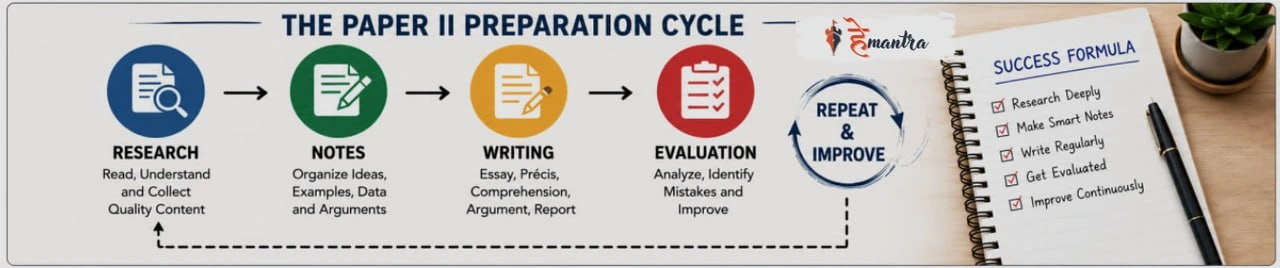
The correct cycle is:
Write → Evaluate → Identify Mistakes → Rewrite → Improve
Evaluation should tell you:
- Is your introduction relevant?
- Is your essay balanced?
- Are paragraphs connected?
- Are examples relevant?
- Is your language repetitive?
- Are there grammatical errors?
- Are your arguments superficial?
- Is the conclusion effective?
- Are you completing the paper within time?
Then work specifically on those weaknesses.
The HeMantra R³ Approach for Paper II
A beginner can think about Paper II preparation through three broad stages:
1. Research
Understand the topic properly.
Read quality newspapers, reports, official sources and standard material.
2. Reflect
Ask questions.
Why?
How?
What are the consequences?
What is the opposing view?
What can be done?
3. Reproduce
Convert your understanding into:
- paragraphs,
- essays,
- arguments,
- précis,
- comprehension answers,
- reports.
This is how information becomes examination-ready knowledge.
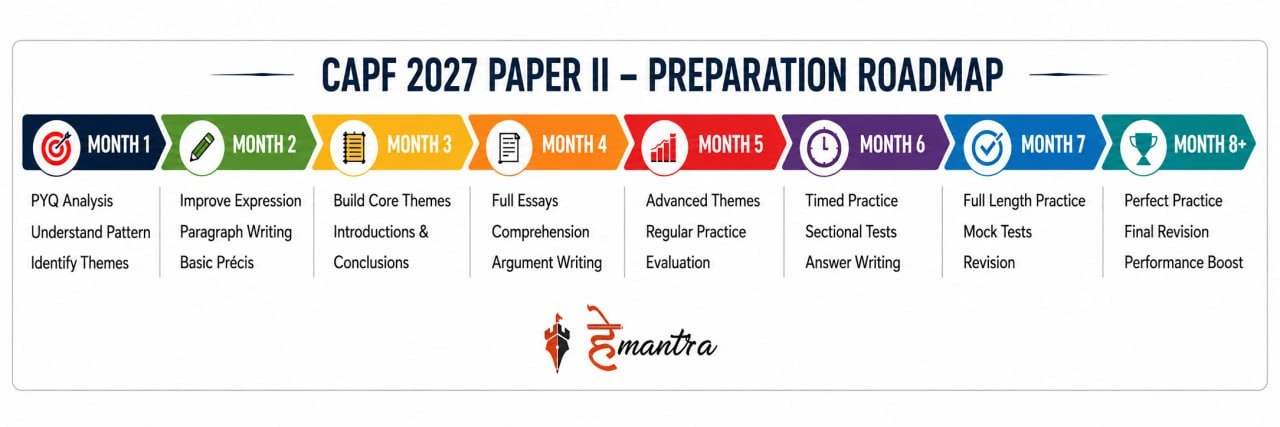
A 6–8 Month CAPF 2027 Paper II Roadmap
Here is a practical progression for a beginner.
Phase | Focus |
Month 1 | PYQ analysis + basic expression + newspaper reading |
Month 2 | Paragraph writing + grammar improvement + basic précis |
Month 3 | Core themes + introductions + conclusions |
Month 4 | Full essays + arguments + comprehension |
Month 5 | Advanced themes + regular evaluation |
Month 6 | Timed writing + sectional tests |
Month 7 | Full Paper II practice + revision |
Month 8 onward | Mock tests + evaluation + correction of weak areas |
The exact timeline can change depending on how much time remains before the examination.
But the progression should remain:
Foundation → Content → Expression → Practice → Evaluation → Simulation
CAPF 2027 Paper II: 30-Day Beginner Plan
If you are starting today, follow this simple first-month strategy.
Week 1: Understand the Examination
- Read the Paper II syllabus.
- Analyse previous-year papers.
- Identify recurring themes.
- Assess your current English level.
- Write one diagnostic essay without external help.
Do not worry about the quality.
This is your starting point.
Week 2: Build Expression
Every day:
- Read one editorial.
- Write one 100–150 word paragraph.
- Learn 5–10 useful expressions.
- Correct your common grammar errors.
Do not memorise random difficult vocabulary.
Learn words you can actually use.
Week 3: Build Structure
Practise:
- 5 essay introductions,
- 5 conclusions,
- argument writing,
- one précis every alternate day,
- comprehension exercises.
Start developing notes for 3–4 major themes.
Week 4: Start Complete Writing
Attempt:
- 2 complete essays,
- 2 précis exercises,
- 2 comprehension exercises,
- argument/report writing practice.
Get your work evaluated.
Identify your three biggest weaknesses.
Your next month’s preparation should focus on those weaknesses.
Daily Routine for CAPF Paper II
You do not need three hours every day.
Even 45–60 focused minutes can make a significant difference when practised consistently.
A beginner can follow:
20 minutes
Read an important editorial/current-affairs issue.
15 minutes
Make concise writing notes.
20 minutes
Write a paragraph/introduction/argument/précis.
5 minutes
Review and correct your writing.
On weekends, attempt a longer answer or full essay.
Consistency matters more than occasional marathon sessions.
Important Topics for CAPF 2027 Paper II Preparation
Your topic list should continue evolving with current affairs, but some broad areas deserve systematic preparation:
Economy
- Employment
- Agriculture
- Manufacturing
- MSMEs
- Service Sector
- Infrastructure
- Inclusive Growth
Society
- Women Empowerment
- Education
- Healthcare
- Population
- Urbanisation
- Social Media
- Youth
Governance
- Judicial Reforms
- Electoral Reforms
- Federalism
- Transparency
- Civil Services
- Technology in Governance
Security
- Terrorism
- Cyber Security
- Border Management
- Left-Wing Extremism
- Organised Crime
- Artificial Intelligence and Security
- Drones
- Social Media and National Security
Environment
- Climate Change
- Disaster Management
- Pollution
- Sustainable Development
- Renewable Energy
- Water Security
International Issues
- India’s Neighbourhood
- Global Institutions
- Regional Cooperation
- Geopolitical Conflicts
- India’s Strategic Interests
Do not merely read these topics.
Develop arguments and perspectives around them.
what Mistakes CAPF 2027 Aspirants Must Avoid ?
Mistake 1: Starting Paper II After Paper I
Prepare them simultaneously.
Mistake 2: Collecting Too Many Resources
A small number of reliable resources used repeatedly is better.
Mistake 3: Memorising Model Essays
Learn frameworks and arguments instead.
Mistake 4: Ignoring Précis and Comprehension
Paper II is not only essay writing.
Mistake 5: Using Unnecessarily Difficult English
Clarity is more valuable than vocabulary exhibition.
Mistake 6: Writing Without Evaluation
Without feedback, repeated practice can reinforce mistakes.
Mistake 7: Never Writing Under Time Pressure
Eventually, every component must be practised under examination conditions.
What If You Are From Hindi Medium?
Your medium should not become a psychological barrier.
You do not need to become a novelist. You need functional, accurate and analytical English.
Start with:
Thought → Simple English → Better Structure → Better Expression
Not: Hindi Sentence → Word-to-Word Translation → Complicated English
Read good English every day.
Write short paragraphs.
Observe sentence patterns. Rewrite weak sentences. Get corrections. Within a few months, improvement becomes visible. Language improves through exposure and usage.
How HeMantra Approaches CAPF Paper II Preparation
At HeMantra, we treat descriptive writing as a process rather than a collection of model answers.
The focus is on:
Research → Conceptual Clarity → Notes → Expression → Writing → Evaluation → Improvement
For CAPF 2027 aspirants, the objective should not merely be to “complete Paper II”.
It should be to develop the ability to independently handle an unfamiliar topic in the examination hall.
That requires:
- understanding core descriptive themes,
- learning essay structure,
- improving English expression,
- practising précis and comprehension,
- analysing previous-year questions,
- writing regularly,
- and receiving detailed feedback.
Internal Link: ABHYAS LEKHAN 2027 — CAPF Paper II Descriptive Programme
HeMantra’s ABHYAS LEKHAN 2027 programme currently includes Paper II-oriented lectures, core descriptive themes, study material, essay/précis/comprehension practice, PYQ discussion, writing assignments and answer evaluation.
Internal Link: CAPF AC PYQs 2026–2020
Before beginning topic prediction, use the actual previous-year questions to understand UPSC’s demand.
Frequently Asked Questions — CAPF 2027 Paper II
When should I start preparing CAPF 2027 Paper II?
Start from the beginning of your CAPF preparation. Paper II requires writing skills, and writing ability needs time to develop.
Can I prepare CAPF Paper II in three months?
It is possible to improve substantially in three months with disciplined practice, but starting earlier gives you more time to develop content, English expression and examination temperament.
Is CAPF Paper II difficult for Hindi-medium students?
It can initially be challenging because précis, comprehension and other language components require English. However, systematic daily practice can significantly improve functional English and written expression.
Should I read newspapers for CAPF Paper II?
Yes, but read selectively. Focus on important national, international, economic, social, environmental and security issues and extract arguments rather than copying entire articles.
How many essays should I write before CAPF?
There is no magical number. Ten properly evaluated and rewritten essays may be more valuable than fifty unevaluated essays.
Which newspaper is best for CAPF Paper II?
Choose one reliable national newspaper and focus on editorials and major analytical issues. The purpose is not to read everything but to develop content and perspective.
How can I improve English for CAPF Paper II?
Read quality English, write every day, correct grammar errors, practise sentence restructuring and get your answers evaluated. Avoid relying only on vocabulary lists.
Is essay writing enough for CAPF Paper II preparation?
No. Your preparation must include Essay, Précis, Comprehension and other writing/communication skills prescribed in the examination pattern.
Are previous-year questions important for CAPF Paper II?
Yes. PYQs are the best starting point for understanding recurring themes, question framing and the level of analysis expected by UPSC.
Should I memorise model essays?
No. Use model essays to learn structure, examples and expression, but build your own content and argumentation.
Final Strategy for CAPF 2027 Aspirants
If there is one thing you should remember from this article, remember this:
Do not wait until your English becomes perfect before you start writing. Your English improves because you start writing.
You may write a weak paragraph today.
That is fine. Correct it.
Write another tomorrow.
Research better.
Develop stronger arguments.
Practise précis.
Analyse editorials.
Build topic-wise notes.
Get your writing evaluated.
Rewrite your mistakes.
Do this consistently for the next several months.
By the time CAPF 2027 arrives, you should not be asking:
“How do I write an essay?”
You should be asking:
“Which dimensions will make this particular essay better?”
That is the transformation we want.
Paper II is not prepared in the final 30 days.
Paper II is built one paragraph at a time.
Start Today.
Research. Think. Write. Evaluate. Improve.

[…] How to Prepare UPSC CAPF AC 2027 from Zero […]