Aadhaar card vs Citizenship
📅 Last updated: August 22, 2025 2 min read
📰 Why in News?
-
From October 2025, people above 18 years in
Assam
will not be issued first-time Aadhaar cards.
-
This decision, announced by
Chief Minister Himanta Biswa Sarma,
aims to prevent illegal immigrants, particularly from
Bangladesh,
from obtaining Aadhaar to claim Indian citizenship.
-
A one-year relaxation is provided for
Scheduled Castes (SCs),
Scheduled Tribes (STs), and
Tea Garden (Adivasi) workers.
-
Authorities note that
Aadhaar saturation in Assam is 103%,
indicating almost all eligible residents already possess Aadhaar.
📰 Why in News?
- From October 2025, people above 18 years in Assam will not be issued first-time Aadhaar cards.
- This decision, announced by Chief Minister Himanta Biswa Sarma, aims to prevent illegal immigrants, particularly from Bangladesh, from obtaining Aadhaar to claim Indian citizenship.
- A one-year relaxation is provided for Scheduled Castes (SCs), Scheduled Tribes (STs), and Tea Garden (Adivasi) workers.
- Authorities note that Aadhaar saturation in Assam is 103%, indicating almost all eligible residents already possess Aadhaar.
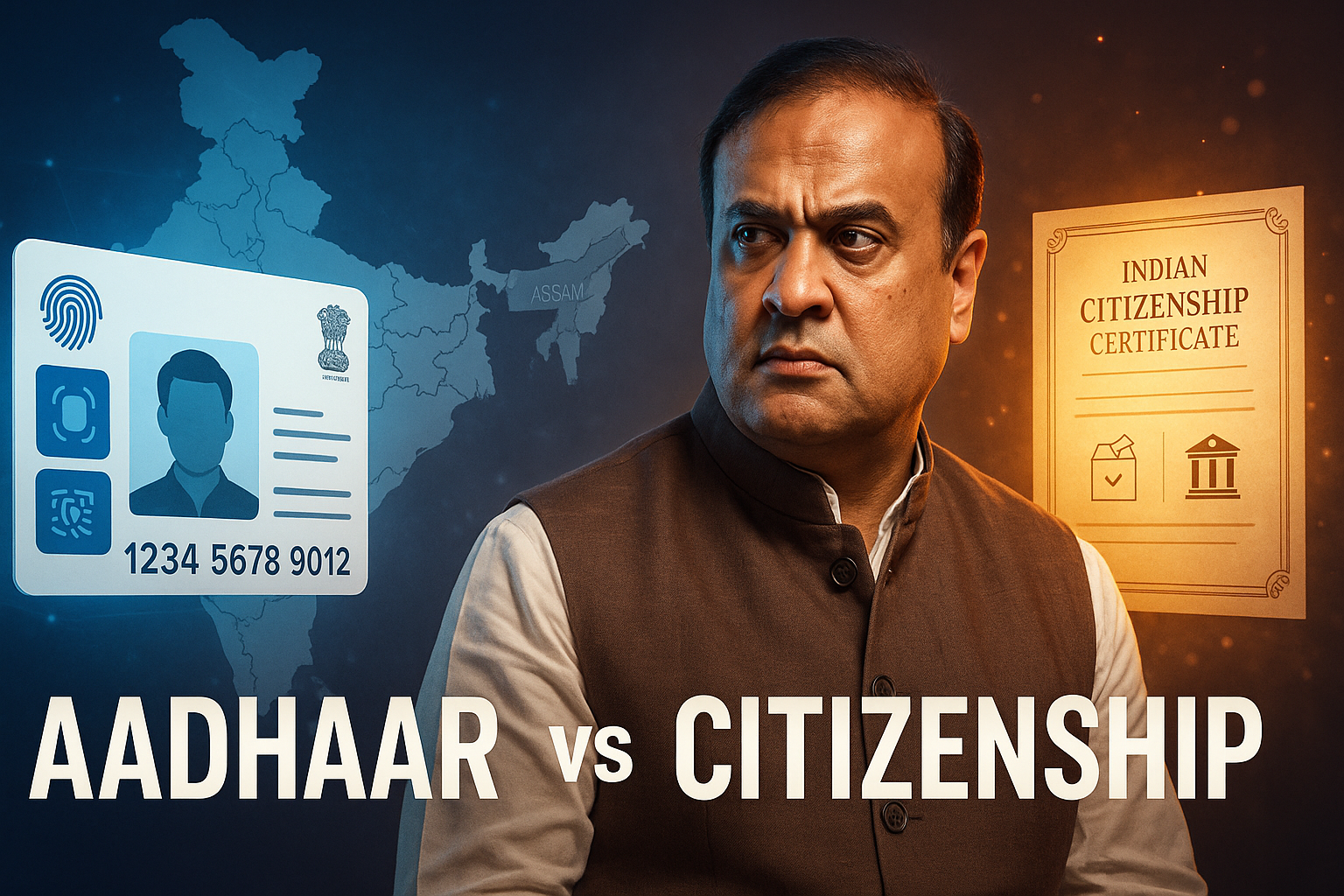
🌐 Aadhaar vs Citizenship in India
🔹 What is Aadhaar?
- 12-digit unique ID issued by the Unique Identification Authority of India (UIDAI) to residents based on verified demographic and biometric data.
- Serves as proof of identity and address, linking individuals to government and private services through biometrics: fingerprints, iris scans, and facial photographs.
- Available for Indian residents with continuous stay of more than six months, including foreigners residing in India for six months or more.
- Facilitates access to banking, mobile connections, welfare schemes, taxation, and digital services, forming a core part of India’s digital infrastructure.
⚠️ Key Concerns About Aadhaar
- Misuse as Proof of Citizenship or DOB – Despite UIDAI disclaimers, some institutions still accept Aadhaar for age or citizenship verification, leading to potential administrative and legal conflicts.
- Privacy & Security Risks – Centralized storage of sensitive biometric and demographic data creates vulnerability to breaches, identity theft, and potential government or third-party surveillance.
- Biometric Authentication Challenges – Errors due to poor-quality devices, aging fingerprints, or data mismatches can deny residents access to essential services, disproportionately affecting vulnerable populations.
- Legal & Ethical Debate – Aadhaar’s mandatory integration with services raises constitutional questions under Article 21 (Right to Privacy) and principles of non-discrimination.
🌍 Citizenship Overview
- Definition: Legal status linking an individual to the Indian state, granting rights such as voting, property ownership, and welfare access, and imposing duties like taxation and defense obligations.
- Law: Citizenship Act, 1955 defines five ways to acquire Indian citizenship:
- Birth in India under certain conditions
- Descent from Indian parents
- Registration for certain categories (e.g., overseas citizens, residents)
- Naturalization for long-term foreign residents meeting eligibility criteria
- Incorporation of territory into India
- Loss of Citizenship: Termination, deprivation for legal reasons, or voluntary renunciation.
- Proof: Birth certificate serves as legal proof of identity, age, and citizenship, as mandated by the Registration of Births and Deaths Act, 1969.
- Jurisdiction: Parliament holds exclusive authority over citizenship under the Union List; courts interpret but cannot create citizenship rights.
🎯 Identity vs Legal Status
🆔 Aadhaar
- Proof of identity & address
- Issued to residents based on documents & continuous stay
- Facilitates access to services and subsidies
- Does not confer legal citizenship
🇮🇳 Citizenship
- Legal recognition as a member of India
- Grants constitutional rights and imposes duties
- Acquired via birth, descent, registration, naturalization, or territory incorporation
- Cannot be replaced by Aadhaar or administrative ID
🔍 Insights & Implications
- Policies like Assam’s highlight the need to prevent misuse of identity systems in border or migration-sensitive areas.
- Explicit disclaimers emphasize distinguishing administrative verification from legal citizenship.
- Biometric reliability, data privacy, and cybersecurity remain central challenges for nationwide identity programs.
- Aadhaar complements governance but cannot substitute for legal recognition; citizenship remains constitutional and judicially protected.
- Awareness among citizens and administrators is crucial to prevent fraud, legal disputes, and exclusion from services.
🧠 Conclusion
Aadhaar is a powerful tool for identity verification and administrative efficiency, but it is fundamentally different from citizenship, which is a legal status granting rights and duties. Clear policies, robust data protection, and public awareness are essential for balancing administrative convenience with constitutional safeguards, ensuring inclusive and lawful governance in India.
🌐 Aadhaar vs Citizenship in India
🔹 What is Aadhaar?
- 12-digit unique ID issued by the Unique Identification Authority of India (UIDAI) to residents based on verified demographic and biometric data.
- Serves as proof of identity and address, linking individuals to government and private services through biometrics: fingerprints, iris scans, and facial photographs.
- Available for Indian residents with continuous stay of more than six months, including foreigners residing in India for six months or more.
- Facilitates access to banking, mobile connections, welfare schemes, taxation, and digital services, forming a core part of India’s digital infrastructure.
⚠️ Key Concerns About Aadhaar
- Misuse as Proof of Citizenship or DOB – Despite UIDAI disclaimers, some institutions still accept Aadhaar for age or citizenship verification, leading to potential administrative and legal conflicts.
- Privacy & Security Risks – Centralized storage of sensitive biometric and demographic data creates vulnerability to breaches, identity theft, and potential government or third-party surveillance.
- Biometric Authentication Challenges – Errors due to poor-quality devices, aging fingerprints, or data mismatches can deny residents access to essential services, disproportionately affecting vulnerable populations.
- Legal & Ethical Debate – Aadhaar’s mandatory integration with services raises constitutional questions under Article 21 (Right to Privacy) and principles of non-discrimination.
🌍 Citizenship Overview
- Definition: Legal status linking an individual to the Indian state, granting rights such as voting, property ownership, and welfare access, and imposing duties like taxation and defense obligations.
- Law: Citizenship Act, 1955 defines five ways to acquire Indian citizenship:
- Birth in India under certain conditions
- Descent from Indian parents
- Registration for certain categories (e.g., overseas citizens, residents)
- Naturalization for long-term foreign residents meeting eligibility criteria
- Incorporation of territory into India
- Loss of Citizenship: Termination, deprivation for legal reasons, or voluntary renunciation.
- Proof: Birth certificate serves as legal proof of identity, age, and citizenship, as mandated by the Registration of Births and Deaths Act, 1969.
- Jurisdiction: Parliament holds exclusive authority over citizenship under the Union List; courts interpret but cannot create citizenship rights.
🎯 Identity vs Legal Status
🆔 Aadhaar
- Proof of identity & address
- Issued to residents based on documents & continuous stay
- Facilitates access to services and subsidies
- Does not confer legal citizenship
🇮🇳 Citizenship
- Legal recognition as a member of India
- Grants constitutional rights and imposes duties
- Acquired via birth, descent, registration, naturalization, or territory incorporation
- Cannot be replaced by Aadhaar or administrative ID
🔍 Insights & Implications
- Policies like Assam’s highlight the need to prevent misuse of identity systems in border or migration-sensitive areas.
- Explicit disclaimers emphasize distinguishing administrative verification from legal citizenship.
- Biometric reliability, data privacy, and cybersecurity remain central challenges for nationwide identity programs.
- Aadhaar complements governance but cannot substitute for legal recognition; citizenship remains constitutional and judicially protected.
- Awareness among citizens and administrators is crucial to prevent fraud, legal disputes, and exclusion from services.
🧠 Conclusion
Aadhaar is a powerful tool for identity verification and administrative efficiency, but it is fundamentally different from citizenship, which is a legal status granting rights and duties. Clear policies, robust data protection, and public awareness are essential for balancing administrative convenience with constitutional safeguards, ensuring inclusive and lawful governance in India.